
The Hydrangea Whisperer
A quintessential Cape shrub gets its close-up in C.L. Fornari’s informative new book.

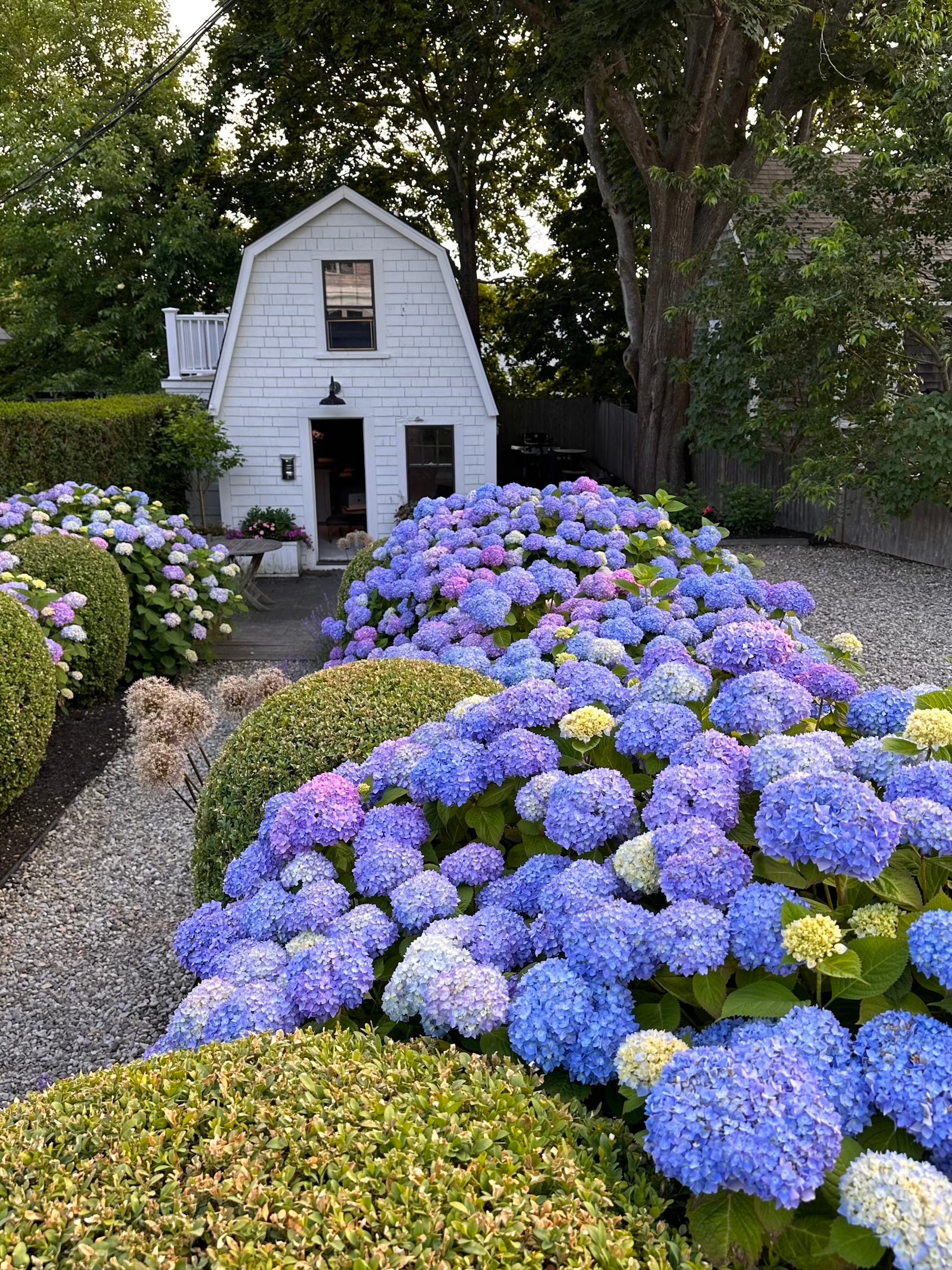
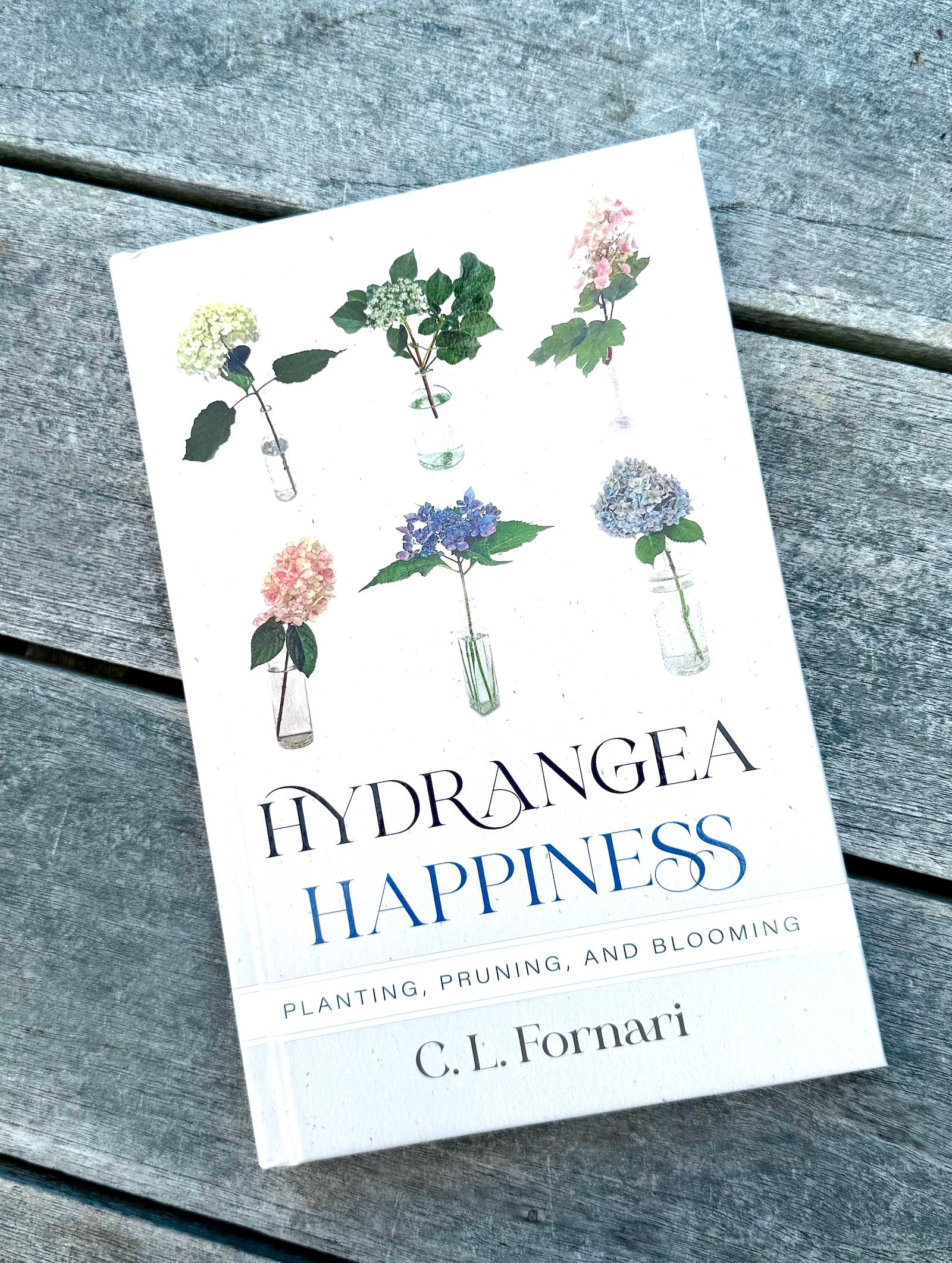
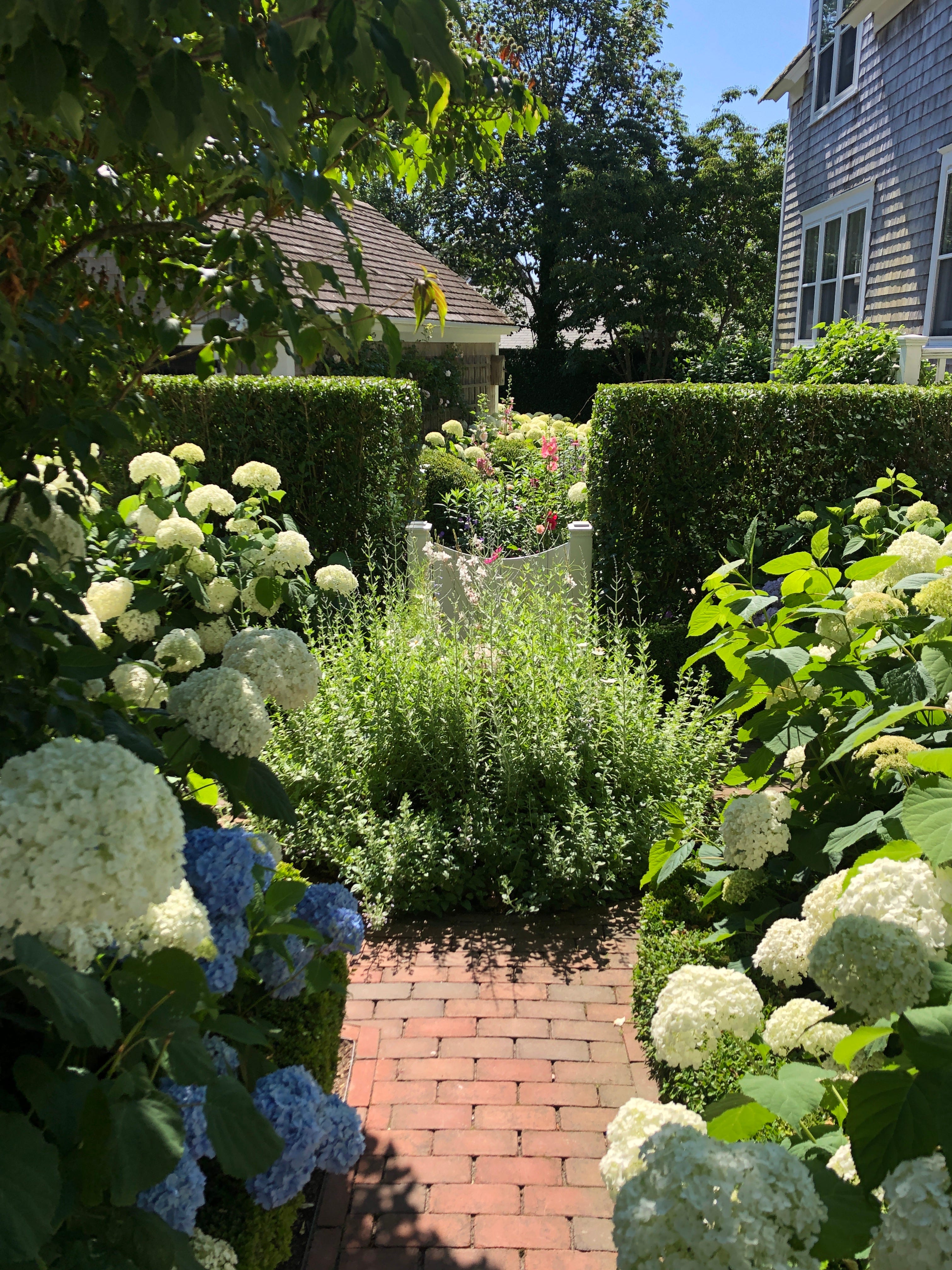
When you need health information you go to a doctor. And when you need advice about growing hydrangeas on Cape Cod you go to C.L. Fornari. Many readers will know C.L. from her garden books, including Sand & Soil: Creating Beautiful Gardens on Cape Cod and the Islands, and her radio show The Garden Lady on WCAI and WGBH. Her new book from Brandeis University Press, Hydrangea Happiness: Planting, Pruning, and Blooming, is full of helpful tips and visuals on the best to grow varieties of this quintessential Cape and Islands family of shrubs. One of the first thing you’ll learn is that not all hydrangeas are the same. And, as someone who has struggled growing hydrangeas in my own Truro garden, I had a lot of questions for C.L..
Q: Hydrangea Happiness is a lovely book. I really like the smaller format and the beautiful but instructional presentation of the visual material. Why did you want this particular format?
A: One reason I wanted to write this book was because I’m the admin of the Hydrangea Happiness Facebook group and there’s a lot of confusion out there about these shrubs. I didn’t want to do the usual coffee table book, and I didn’t want to do a comprehensive reference book like Michael Dirr’s Hydrangeas for American Gardens, which is excellent but many of the plants listed are no longer available in the nursery trade. I didn’t want to get people excited about plants they can’t buy.
Q: I’m at the sandy tip of Cape Cod here in Truro. There are hydrangeas around, but not as many as in other parts of the Cape where maybe the soil is richer and everybody’s front yards are full of hydrangeas. The few that I’ve planted are having a hard time during the summer with drought. How do you advise us sandy gardeners? Are we just not doing it right or do we just not have suitable soil conditions?
A: No, it’s not that. Frankly, there are only a few places on the Cape where we have real dirt. In most of the Cape and Islands when you dig down 10 inches, you hit the beach. However, I think one of the big differences is that there aren’t as many tall trees as you drive out Route 6. The trees get shorter and shorter particularly from Orleans on. It’s a matter of the wind and exposure and the fact that anything that grows large out there gets taken down by whatever hurricane comes along. That tree cover makes a difference for shade, which most blue hydrangeas need. It also makes a difference with falling leaves that enrich the soil from the top down as they drop year after year after year. And I think the further out in the Cape you go, the less of that soil-building there is.
Q: This book is for gardeners around the country, but for us Outer Capers, what group of hydrangeas should we be looking to grow?
A: The panicle hydrangeas are Mr. Dependable in your conditions. You’re not just limited to the classic white/pink Hydrangea paniculata Grandiflora or chartreuse ‘Limelight’. They’re large plants and not everybody has space for those them. New varieties such as ‘Fire Light’ are also wonderful. It is one of my favorites because it flowers earlier, still reaching six feet tall, but it’s more compact than ‘Limelight’. The flowers turn dark pink toward the end of August and then wine red in September. There’s a shorter version named ‘Fire Light Tidbit’ that grows to three feet tall and has the same fairly early flowering and color. It goes from white to pink very nicely. ‘Little Quick Fire’ is another type with a lacy flower that turns a lovely shade of pink, blooms earlier, and tops out at about five feet tall.
Q: What is it about the panicle varieties that makes them easier?
A: They’re very hardy. The breeders have selected for stem sturdiness as well as for early flowering, smaller sizes, color, and all the other things that gardeners want. But that stem sturdiness is good as well because the plants form their flower buds in the spring and not the previous year. Even when it’s cold and windy here in March and April they go ahead and form their flowers, unlike mopheads which can have their flower buds that are formed the previous year damaged in a winter cold snap.
Q: What others would you recommended, even if they are a little more challenging?
I think the smooth hydrangeas (H. arborescens) are good because they do well in either full sun or part sun. They are a little thirstier than the paniculatas and the oakleaf hydrangeas (H. quercifolia), but not as much as the classic blue or pink mopheads (H. macrophylla). Those are the flowers that most people picture when they think of a hydrangea.
Q: Yes, I’m struggling more with the hydrangeas that everyone expects to see here, the mopheads. My oakleaf hydrangea is doing great three years on in a situation that is directly exposed to winter storms from the Back Shore. Is there no hope for me growing that classic blue hydrangea?
A: The mopheads/macrophyllas are the prima donnas of the hydrangea world. I often say Auntie Mac has a little bit of a drinking problem. She not only likes her liquids, but she can’t quite get enough of them much of the time. That’s the problem, particularly if you’re trying to grow them where there isn’t enough shade. Their big flowers and large leaves lose moisture so quickly that even if your soil is hydrated with moisture and you’re irrigating, the plant can’t pull it up fast enough before it evaporates. And when you’re out where there’s a constant sea breeze that’s blowing that moisture away, it’s even worse.
Now, I will say that the series that’s been rebranded as ‘Magical’ hydrangeas. They were originally sold as the Everlasting group. Hydrangeas like ‘Magical Revolution’ were originally bred for the cut flower trade. So, they were bred to be very stem sturdy and the blossoms, the sepals that make up what we view as flowers, are thicker. ‘Magical Revolution’ is better for gardeners further out in the Cape because it is sturdier and its leaves are thicker so it doesn’t seem to lose the moisture as quickly. I have one in my full sun front garden and it does not brown out in August like any normal mophead would.
Q: What does drought stress looks like? Is it mainly the browned edges on the leaves or just wilting, which is something mine do a lot?
A: No, the actual flowers turn brown. Once they wilt several times, which they will on an 80-degree day in the sun with a sea breeze, the entire flower will brown out.
Q: When I first gardened on Cape Cod five years ago, everybody on social media said, “oh, your hydrangeas must be amazing!” And I felt almost like a bad newcomer that the few I had were just limping along. I have a couple and they’re kind of limping along. And I noticed previously on visits to Nantucket how that island seems to be a hydrangea paradise. What are they doing that I’m not?
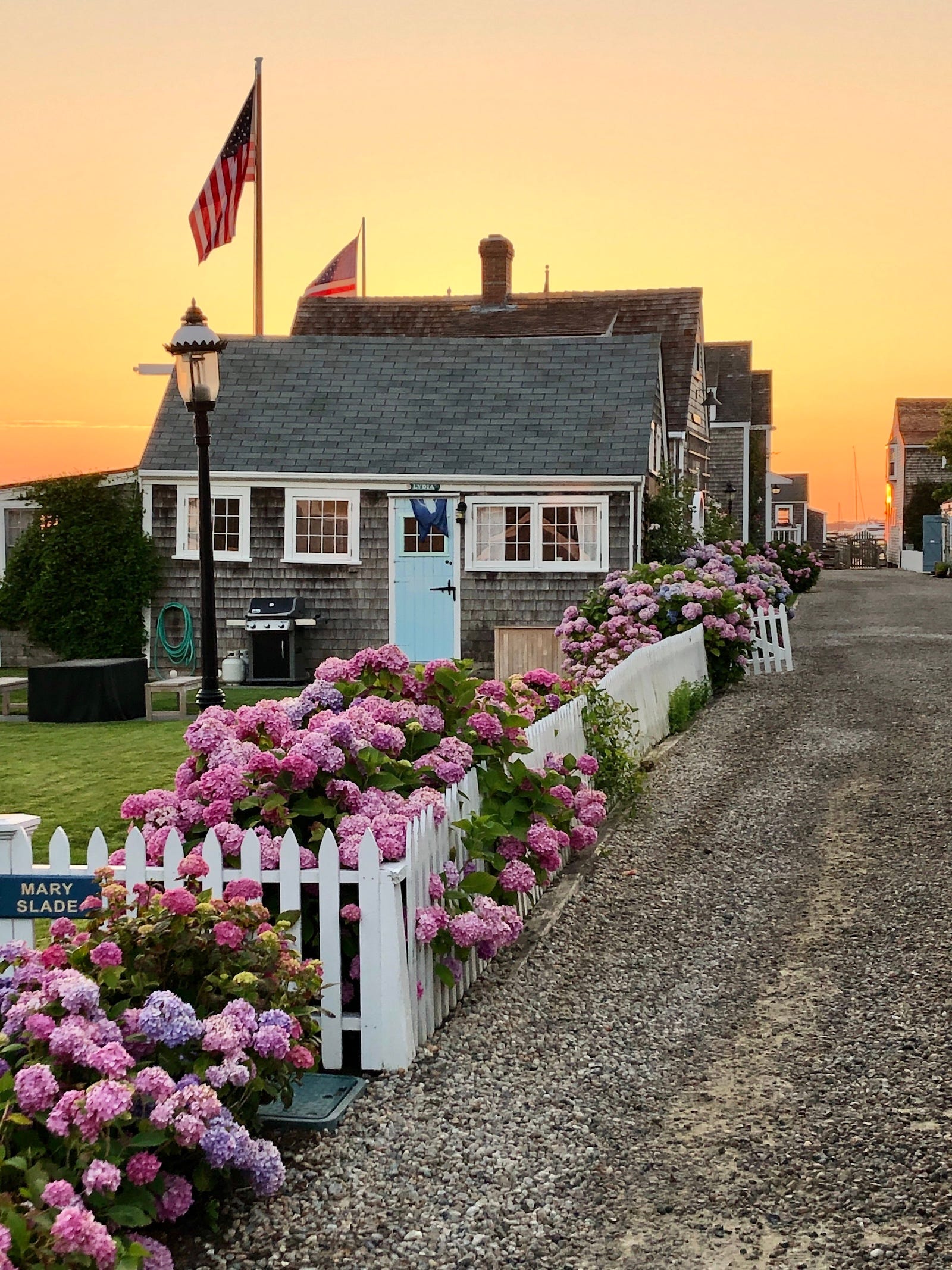
A: Well, watering a lot perhaps, but it also depends on how you’re defining success. Because if you’re defining success that they look great all summer and into the fall, then it’s all about the shade and protecting them from the afternoon sun specifically. Also, you should be siting them if you can so that they are not in a wind tunnel. Around Nantucket, a lot of hydrangeas are sheltered by large old buildings in town, or fences, or old hedges, and those windbreaks protect the hydrangeas in both summer and winter.
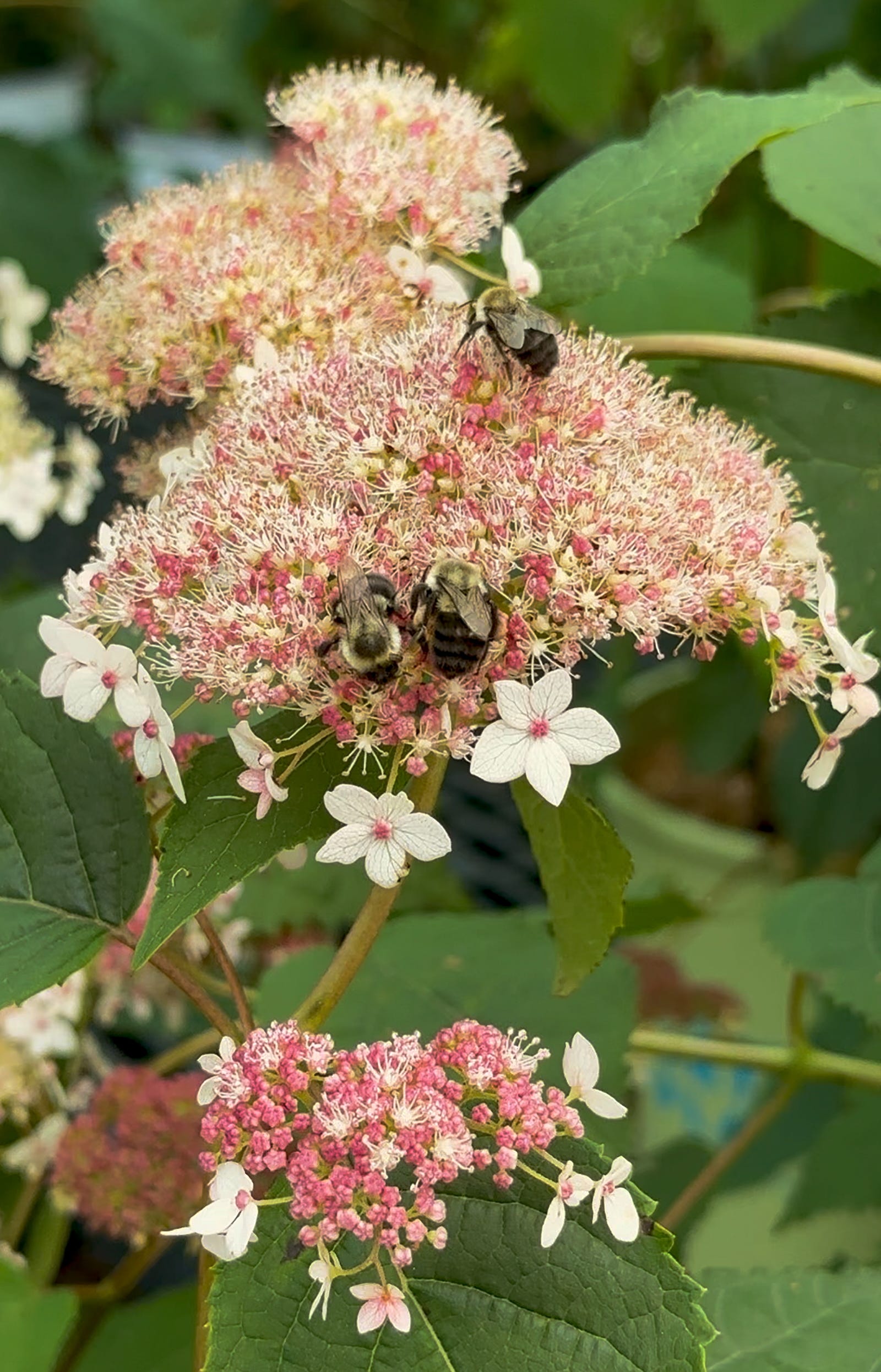
Q: Some hydrangeas get criticized for being sterile or not having availability to pollinators. Tell us a little bit about hydrangeas that are helpful to pollinators if we want to garden for wildlife.
A: There are several arborescens, not ‘Annabelle’ so much, but ‘Haas’ Halo’, ‘Pinky Pollen Ring’, and ‘Invincibelle Spirit II’ which is similar to a pink Annabelle, are arborescens that support a lot of pollinators. But I would look first for natives from the East Coast, arborescens ‘Invincebelle Lace’, and the oakleaf hydrangeas. I wish somebody would start selling more of the straight native arborescens, but they are not as sexy as the big round ones like ‘Annabelle,’ or as colorful as the pink varieties. But as for natives or pollinator plants, I think we need to plant for diversity. We need native plants and native cultivars, but we also need plants that can put food on our tables and that lift our hearts. And if a sterile blue hydrangea lifts your heart, then grow it!
Q: What should gardeners know about placement and safely siting hydrangeas for wind, storms, sun, heat, etc.?
A: That’s what you have to hammer home if you’re talking about the macrophyllas and the mountain hydrangeas (H. serrata), which are also known as lacecaps, especially if you want them to keep going past July. They have to be shaded from about 11 o’clock AM on. Afternoon shade is crucial. Also give them organic amendments from the top down, which is how nature does it. A layer of compost followed by an inch of mulch, whether that’s chopped up leaves or seaweed or bark mulch. But that constant organic matter from the top down is important.
Q: I’ve hesitated with some of the arborescens because I know they have staking issues and are known to flop because they are so top-heavy. How do you handle staking?
A: Yes, ‘Annabelle’ is not at all stem-sturdy. It’s just a genetic thing. But the new varieties of arborescens have been chosen for stem sturdiness. Look for the new ‘Storm Proof ‘or ‘Flowerfull’.
Q: What about fertilizing or feeding other than compost and top dressing?
A: I always tell people to have a soil test done to see if you need to fertilize. And be aware that in places where you have such sandy soil, it doesn’t hold on to nitrogen. I always go organic for shrubs and trees. The fertilizer companies have convinced us that we all need to be fertilizing several times a year and it’s not true. I often say it’s like the shampoo companies that print “rinse and repeat” on their bottles. Nobody needs to shampoo their hair twice. The fertilizer companies want you to apply twice a year so that you’ll use the product up and buy more. If your plants are growing well, you may only need a light application of organic fertilizer in the spring. But let an occasional soil test be your guide.
Q: Gardeners can really fixate on changing the color or altering their flower color from pink to blue or vice versa. Tell us about that.
A: The two species that this practice works on are the serratas and the macrophyllas. It doesn’t happen at all for the arborescens or the paniculatas. In general on Cape Cod, if we do nothing our hydrangeas will be blue because we already have aluminum in the soil and our soil is acidic.
Most native soils around the Cape test at about 5.5 pH. If you have a ‘Nikko Blue’ or ‘Endless Summer’ macrophylla that’s kind of a mid-blue, it’s never going to be dark blue or dark purple. The depth of color is a genetic thing. There are also site factors that can change the pH of your native soil, like if you lime your lawn or if there is a cement or stone dust path or driveway near a planting area the flowers can be pinker.
Q: You do some mythbusting in your book. What are some common hacks you’d like to debunk?
A: Well, there a lot of them about altering flower colors. It used to be putting rusty nails around the bushes to turn them blue. And there are still some people who are determined that’s true. But it’s really just keeping the soil acidic that does it. Use sulfur to lower the pH if you need to. A newer one is that banana water has some sort of magic effect for plants. So people are living with jars of rotting banana peels floating in water for no reason.
Q: There is a hydrangea I enjoy walking by in Provincetown that is a dark purple indigo/amethyst . What varieties offer that darker tone?
I would guess ‘Summer Crush”. It’s marketed as a deep pink but in our acidic soils it becomes deep blue to deep purple as the fall goes on. It’s a fairly new variety that grows to about four feet tall and it is very stem sturdy and quite bud hardy over the winter.
Q: You recommend growing hydrangeas in containers. What’s the best way to protect the container and plants over our cold, windy, stormy winters?
A: You can leave hardier varieties like paniculatas outside in a frost-proof container. You may want to pull them up close to the house in a sheltered spot so that they are not whipping around in the wind. If you want to grow mopheads in pots, the best thing is to store them where you store your lawn furniture an unheated garage. That’s what I do every year and it’s quite successful, but do check the soil every few weeks to make sure it isn’t bone dry.
Q: When and how to prune is a question that seems to confuse everyone because, once again, not all hydrangeas are alike. What’s an easy to figure that out?
A: Most people are concerned about when to prune the mopheads and lacecaps. I say prune them in the spring when the leaves are about the size of a dime and you can clearly see what branches are living and what’s dead. You want to leave anything that has any green leaves on it in the beginning of May. And don’t try to make them shorter, say to stay underneath a kitchen window, or to make them more symmetrical because they replace their growth in three short months. The more you cut off of these plants, the fewer flowers you will get. Sometimes you’re only taking off the top two or three inches of the plant. If you’ve got a straight up stem that has a viable green bud at the top of that stem, by all means do not cut that back because that’s going to be one of the biggest, best flowers you’ve got.
The same goes for the oakleaves because they also form their flower buds in advance. So, just remove any dead wood. Paniculatas are a little bit different. What you want to do is look at any branch that is headed into the center of the plant instead of out and away from the center. Follow it back to where it joins another branch and cut there. The problem is people routinely just cut paniculatas back from the top down and everywhere you make a cut doubles or triples the growth underneath. Then you get a congested plant with branches going here there and rubbing in spots that can cause wounds where diseases can get into the wood.
Q: And what happens if I don’t do any pruning or cutbacks? Often, we gardeners can overdo instead of letting things be.
A: If you don’t, the worst that will happen is that when your hydrangeas are in bloom, you’ll have some dead branches poking out, which distracts a little bit from how they look. With the mopheads, the old flowers will fall off over the winter and may become what we call Cape Cod tumbleweeds that blow all over the place. But that’s not a problem.
Q: My last question may be a difficult one. What is your favorite hydrangea?
A: Ah well, hmm, whatever I looked at ten minutes ago!
When my mother passed just this May, we had the funeral on May 11, the day after Mother's day. I live in Delaware, she lives in SE PA. We both love blue hydrangeas. Every florist I called for the funeral arrangements were like good luck, it's Mother's Day, you cannot get a bunch of blue hydrangeas. Luckily I ran into a new variety at Lowes of all places (mine is terrible to plants never water them) but fresh off the truck. They went 3 hrs to PA in my trunk, to the funeral home, to the church, to the graveside, to my mother's home for the wake, then 3 hours back to Delaware with me. And they are still blooming like crazy. So check these out - if I find them again they are a definite buy! Hydrangea Horizon Blue...https://www.monrovia.com/hitm-horizon-blue-hydrangea-48199.html. And Mom had her blue hydrangeas...
I, too, love hydrangeas, but keep the oakleaf species. Why? Mainly because I life the fall color as much as the bloom.